Showing posts with label Roberto Bolaño. Show all posts

Monday, 16 January 2012

The Third Reich by Roberto Bolaño

Are dark, sinister forces at work, the embodiment of evil, or is the narrator, Udo Berger, just losing touch with reality and experiencing the world through a cloud of paranoia?
He is a German on holiday with his girlfriend Ingeborg in a Mediterranean coastal resort in the Catalonian region of northern Spain.
While Ingeborg suns herself on the beach, Udo works in his hotel room on strategies for a board game called The Third Reich.
He is an arrogant man, contemptuous of the frivolity of the tourists around him and full of self-importance over his reputation as a champion gamer.
Udo and Ingeborg fall in with another German couple, Charly and Hanna, and through them with two Spaniards, the Wolf and the Lamb, who Udo tolerates rather than likes.
He is also drawn to a badly scarred man El Quemado (the burnt one), who hires out pedal boats to tourists during the day and sleeps beneath them on the beach at night.
Charly seems to be going off the rails, drinking heavily and getting in to fights, disappearing until one day he sails out to sea on his windsurf board and doesn’t return.
As events unfold Udo becomes haunted by the notion that there is a guiding hand, or force, behind what is unfolding and is convinced that El Quemado is the personification of that force.
As he watches people coming and going in a hotel “convinced they were at the center of the universe” Udo muses: “What did it matter whether Charly was alive or not, whether I was alive or not? Everything would roll on, downhill, toward each individual death. Everyone was the center of the universe! The bunch or morons! Nothing was beyond their sway! Even in their sleep they controlled everything! With their indifference! Then I thought about El Quemado. He was outside. I saw him as if underwater: the enemy.”
Ingeborg and Charly’s girlfriend, Hanna, return to Germany, leaving Udo alone with the Spaniards and to begin a game of The Third Reich with El Quemado in which the stakes are never defined but which Udo becomes convinced will result in a terrifying forfeit.
He tells the German-born hotelier, whose husband is dying, and with whom Udo has an unconsummated affair: “And if I tell you that I feel something intangible, strange, circling around me in a threatening way, do you believe me? A higher force keeping watch over me.”
This “forgotten” novel by the late Roberto Bolaño was apparently discovered among his papers after the Chilean novelist’s death.
It has a raw and unfinished feel to it, as if he were working out ideas, playing with tropes and styles, all of which more fully realized in his later, more mature fiction.
There are better Roberto Bolaño novels already out there, but The Third Reich stands up well and gives us an intriguing insight into how their author’s world view was informed paving the way for those better novels and the underlying sense of dread and tangible evil that weaves through them.

Sunday, 2 October 2011

Tres by Roberto Bolaño

A series of prose vignettes, an extended verse poem and a sequence of short meditations form the three sections of this bilingual collection.
The first and longest section, Prose from the Autumn in Gerona, reads like a series of scenes in a movie—an experimental European one—in which a narrator living in the Catalonia region of Spain reflects on his life and a nameless woman.
The narrator is a familiar Bolaño creation that, as with so many of his literary personas, reflects the life of the author: a Chilean who has come to Spain via Mexico, an illegal immigrant, a poet imbued with a sense of alienation.
Words, phrases, and images repeat themselves to create a shifting verbal “kaleidoscope” (one of the recurring words) that draws the reader inward.
“Paradise, at times, appears in the general arrangement of the kaleidoscope. A vertical structure covered in grey blotches. If I close my eyes I’ll see dancing in my head the reflections of helmets, the quaking of a field of spears, that thing you called jet. Also, if I cut the dramatic effects, I’ll see myself walking through the plaza by the cinema towards the post office, where I won’t find any letters.”
The next section, The Neochilians, is a verse narrative telling the adventures of a young band traveling through Chile and across the border into Peru.
It is peppered with proper names of band members and those they encounter and the place names of the towns they visit. Straightforward narrative is interwoven with philosophical musing.
It opens with the lines:
“The trip began one happy day in November,/But in a sense the trip was over/When we started./ All times coexist, said Pancho Ferri,/ the lead singer. Or they converge.”
Finally, A Stroll Through Literature is the most uneven section of Tres, burdened by an aimlessness that makes it seem as if it was just thrown together—a few lines on each page that are sometimes not all that interesting.
However, there are moments:
“In these ruins, father, where archeological remains are all that’s left of your laughter.”
Señor Bolaño’s writing can haunt, exposing tears in reality and shifts in perspective and there is plenty in this collection to satisfy those who have already been hooked by the late Chilean’s occasionally flawed but always stimulating output.

Sunday, 27 March 2011

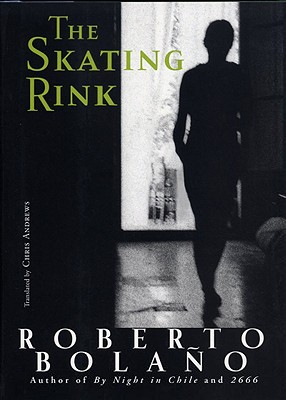
The Skating Rink by Roberto Bolaño

Another Roberto Bolaño novel, an early one, and another little gem to add to the Chilean writer's posthumous canon.
The themes, characters and locations will be familiar to those who have read his more mature works and in many ways you can see him rehearsing some of the narrative techniques he would later develop - particularly in The Savage Detectives.
Three characters, in alternating chapters, come at the same story from different angles, drifting in and out of each other's narratives, reflecting on the same incidents and secondary characters from alternative perspectives.
It is set in Catalunya in the town of Z which lies close to the coast and is busy in the summer months with an influx of tourists.
A senior official siphons of local council funds to build a skating rink in an abandoned mansion for a young champion skater he has become besotted with.
A Mexican businessman who has made good in Spain, who owns shops, hotels and a campsite and who becomes the skater's lover.
And then the Bolañoesque outsider, an illegal immigrant, working as a night watchman at the campsite, trying to stay below the radar of officialdom.
Bolaño maintains a tension throughout in the build-up to a murder, the body found on the secret rink.
He reports from there underbelly of society where it intersects with the comfortable 'respectable' world and occasionally breaks through like an irksome scab.
And as with other novels Bolaño often hints a more mysterious intersection, a slight fracturing in reality that allows an other-worldliness creeps in.
"Sometimes at night, as I walked through the darker parts of the campground, among empty sites and family-size tents strewn with pine needles, I thought of the skating rink and then I was afraid. Afraid that I might come across something from the rink, snagged, hidden in the darkness. Sometimes the air and rats scuttling along the branches of the trees almost made that presence visible..." P158
"... her eyes were covered by the blurry film that was a sign and agent of a force sucking her away toward another reality." P 172
Unsettling as always.
Other Bolaño reviews here.

Sunday, 6 February 2011

Monsieur Pain by Roberto Bolaño

The story concerns Pierre Pain, a hypnotist and alternative doctor, who has been called in to treat the Peruvian poet César Vallejo who is dying of hiccups.
For most of the story Pain has no idea who Vallejo is, merely that he is South American and that his wife is close friend of a Madame Reynaud, who he is in love with.
The fact that Madame Reynaud called on him despite the fact that he was unable to save her husband's life six months earlier gives Pain hope that he might win her affections.
He is a lonely and introspective person but the world that he is drawn into by agreeing to treat Vallejo soon leaves him confused and alienated.
Bolaño is superb at portraying Pain's growing sense of paranoia as it seems that everyone he encounters knows exactly what is going on while he struggles to understand.
The streets of Paris in 1938, where the novel is set, are claustrophobic as Pain is followed by two Spaniards and told to stay away from Vallejo. The hospital where the poet is being treated is labyrinthine and Kafkaesque. Pain is shunned by the medical establishment and eventually evicted by a receptionist.
There are constant hints that something dark and sinister is going, for example when Madame Reynaud unexpectedly and without explanation leaves Paris for Lille, but while Pain seems to be constantly plagued with a sense of uneasiness he remains baffled as to exactly why and how he should react.
The longest scene in the novel takes place in a cinema where Pain narrates that what is happening on screen as well as what is happening to him, gradually the plot of the movie and the plot of the novel begin to intersect as Pain recognises one of the minor characters as former colleague.
Another former student, Plomeur-Boudou, who studied with Pain and the character in the movie is also in the cinema sitting beside one of the Spaniards who had been following Pain.
Plomeur-Boudou confesses that he is working for the Fascists in Spain and using his mesmeric skills to torture anti-Franco Republicans.
Patterns unfold in this novel, scenes or vignettes that seem to echo through later pages and fold back on themselves.
Monsieur Pain is a stylish tale that is effortless to read, yet richly layered, and left me feeling once again in awe of the late Chilean author.

Tuesday, 31 August 2010

The Insufferable Gaucho by Roberto Bolaño

Even the most enthusiastic admirers of the late Roberto Bolaño must wonder sometimes if there is really a case for posthumously publishing everything that he ever wrote.
You could be forgiven for thinking that some of the material being presented as lost masterpieces originated as a few scribbled notes on a torn cigarette packet.
Certainly the first story in this collection, “Jim,” would seem to fit into that category—a brief sketch of the sort of character who weaves in and out of Bolaño’s novels, but who has gotten lost and ended up stranded here by himself with nowhere to go.
However, the other four stories and the two essays in this collection are pure Bolaño gold.
Álvaro Rousselot’s Journey, rather than the collection’s title story—“The Insufferable Gaucho ”—is the stand-out piece.
Another writer could easily have spun out and entire novel from the premise, but in just under 40 pages Bolaño sets the scene, establishes his main character, takes him through a life-changing adventure, and leaves him on the final page psychologically battered and bruised but with new insights into the world.
Álvaro Rousselot is an Argentinian writer, working in the middle of the last century who realizes that the plots of his novels are being plagiarized by a French film director. Three of Rousselot’s novels are thematically outlined by Bolaño, and the character’s development as a writer analyzed before we are even 10 pages into the story.
It gathers pace when Rousselot is given an opportunity to travel to Europe with a delegation of Argentinian authors, some of whose characteristics are briefly outlined—does Bolaño want us to identify them as Borges or Macedonio Fernandez?
When the rest of the delegation returns to Europe, Rousselot travels to Paris where he intends to confront the plagiarist film director. However, he becomes caught up in a swirl of debauchery, drink, and a passionate affair with a prostitute. The scenario has all the hallmarks of a 1970s French movie—perhaps Bolaño knowingly plagiarized the trope, in a self-knowing reversal to the premise of his short story?
The final story is also worth mentioning. “Two Catholic Tales” contains a pair of seemingly disparate narratives that suddenly come together in a twist that Roald Dahl would have been proud of.
Of the two essays which round off the collection, “Literature + Illness = Illness” is the most illuminating, giving us an insight into Bolaño’s psyche as he comes to terms with his own terminal illness. It is not as grim as it sounds and we are given some enlightening insights into the late Chilean’s take on poetry and poetic inspiration.
The Insufferable Gaucho will please existing Bolaño aficionados and serve as a good introduction to newcomers.
(This review was written for and first published on The New York Journal of Books.)

Sunday, 2 May 2010

Antwerp by Roberto Bolaño

On page 66 of this slim novel, a character called Bolaño is quoted as saying: “Tell that stupid Arnold Bennet that all his rules about plot only apply to novels that are copies of other novels.” Perhaps the author inserted this line into the mouth of his eponymous character as a justification for the total lack of plot in Antwerp.
This 78-page book is described by the publisher as an early novel by the late Chilean writer Roberto Bolaño, who died in 2003 aged 50, as one that contains in embryonic form all that the would later write.
Make no mistake, Bolaño would go on to produce a whole range of excellent works of fiction ranging from the gigantic Savage Detectives and 2666 to shorter novels and short stories—translated into English from Spanish.
And yes, in Antwerp you can see the gestation of the themes, writing style, and narrative voice that Bolaño would go on to develop, but it is like watching a long distance runner warming up on the track with a few leg stretches and maybe a short jog.
Anyone who has heard all the hype about Bolaño but never read him before should not go near this because they will certainly conclude that he is a fraud and wonder what all the fuss is about.
However, those who have read Bolaño and become obsessed by him and want to read everything that he ever wrote (and this reviewer counts himself among them) should indulge themselves.
The outcast living on the fringes of society who reincarnates in various guises in Bolaño’s more mature fiction can be seen hovering in the shadows. The gnarled, staccato prose that often aspires to poetry is already fully formed.
But Antwerp’s 56 “chapters”—never running to more than two pages, and sometimes filling just half a page—are really just a series of vignettes with a very loose detective/murder theme running through them.
Most writers will have something similar tucked away in an envelope: the sketches and outlines of a first novel that got sidelined by more structured and fully realized works.
Most of those fragmentary first stirrings will never be published unless their authors also become publishing sensations with a readership hungry for more. It is presumably that audience at whom this stylishly bound little volume is aimed.
(This review was written for an published on The New York Journal of Books.

Tuesday, 12 January 2010

The Savage Detectives by Roberto Bolaño

The detective theme runs loosely through this novel. The two main protagonists, Arturo Belano and Ulises Lima, search for a long-forgotten poet. The narrators, dozens of them, are like a series of witnesses recalling their memories of Belano and Lima and weaving in details of their own lives.
Roberto Bolaño does little to disguise himself as a character – as well as having an almost similar name to his creator Arturo Belano was born in Chile, grew up in Mexico before emigrating to Europe and roaming around France and Spain.
In Mexico City, Belano and Lima are the figureheads in the Visceral Realists, a fringe group of a dozen poets. It is these poets and their partners, friends, families and associates who narrate the Savage Detectives, with Belano and Lima coming in and out of view, sometimes on the merest fringes of the action only to suddenly take up centre stage again.
Before turning to fiction Bolaño was a poet and in this novel he lays bare his passion for poetry and his belief that being a poet demands a total way of being and living rather than a pastime or even an occupation.
There are pages where he simply lists the names of poets, and discussions on poetic technique and academic theory. In Ireland poets tend to be regarded as niche figures, unknown and disregarded among a handful of big names (who most people may have heard of but few will have read), but Bolaño’s young poets are rebellious, anarchic, dangerous, hard-living and full of passion.
They are contemptuous of the establishment figures (including Ocatavio Paz – Mexico’s Nobel Laureate who at one point they plan to kidnap and who even makes an appearance as a character).
However, that youthful passion becomes dissipated as the years pass and the viscerals drift apart, marry, hook up with partners, get jobs and get caught up in the cycle of modern life, working, eating watching television and stagnating. Some continue to write.
Opening in 1975 the Savage Detectives follows the lives of Arturo, and to a lesser extent Ulises, into the mid-1990s, always from the perspective of other narrators into whose lives they drift in an out. It is narrative technique that is unsettling and forces the reader to fill in gaps and make assumptions. Added to this is a chronology which jumps back and forward in time so that you can find your self reading a scene that took part decades before the one that preceded it.
There is an almost supernatural subtext to the story and Arturo and Ulises seem to be cursed. Many of the people they come into contact with suffer ill-health, madness, misfortune and death. Both end up in Europe, living in poverty and working at menial jobs, although always with the hint of continual writing going on although Arturo is the only one who eventually has work published.
The supernatural elements come to the fore in a more tangible way when a boy is falls into a disused mineshaft at a campsite in Galicia where Arturo is working as a watchman. Someone is lowered in to the pit to rescue him is hauled out screaming and says he has seen the devil. When Arturo is lowered in to attempt a second rescue he descends deep and then calls for the rope on which he is being lowered to be cut. While those outside believe that he may have fallen to his death alongside the lost boy he eventually emerges carrying the still-alive missing child.
Bolaño doesn’t overplay the supernatural and it is not a major element but, as in his later novel 2666 (reviewed here) it is there.
The Savage Detectives also calls on its readers to make their own imaginative conclusions. There is no tying up of lose ends. We last see Arturo working as a reporter in an African war-zone heading into a possible massacre, but the narrator of this chapter is unable to fund out any more information about him and there is the suggestion that he is still alive. We last see Ulises standing in a park talking to Octavio Paz but don’t get to find out what he is doing or if, like Arturo he is still writing.
The non-linear narrative and shifting perspectives can be demanding and the loose ends frustrating but then like 2666 the point of these novels seems to be the actual reading and experiencing of it rather than getting to the end to find out what happened.

Tuesday, 13 October 2009

2666 by Roberto Bolaño

Given that Bolaño devotes the first 150 pages or so of his novel to four characters it would be easy to assume that he wants us to identify and develop a relationship with them that will keep us engaged and care what happens to them over the 900 pages of this sprawling book. But when they exit at the end of Book One, that's it and we hear no more of them.
Not that the characters are particularly interesting. They are literary critics, a woman from London and three men from Paris, Madrid and Turin, who are all obsessed by a German novelist called Benne von Archimboldi.
They meet at conventions to discuss the German writer and establish a series of friendships and relationships. They travel to conferences in Europe, to each others' homes, have affairs and form varying degrees of friendship with one another.
Archimboldi, is just a rumour in Book One. He is often name-checked, and his various novels are referred to. The critics meet people who have met him, or claim they have, and arrive at a conference where it is reported that he will appear but fails to do so.
Eventually three of them travel to a (fictional) city in northern Mexico called Santa Teresa, close to the border with the US, where it is reported that Archimboldi is living but they are unable to track him down.
They hear reports of a serial killer on the loose in Santa Teresa, said to be responsible for more than 100 murders.
In Book Two the story is taken up by Amalfitano, who appeared as a minor character in Book One. The Chilean academic lives in Barcelona and is abandoned by his wife to bring up their daughter alone.
The story veers off to cover the unbalanced wife for a while before coming back to Amalfitano who constantly seems on the verge of falling out of sanity. He moves to Santa Teresa with his daughter and once again reports of the numerous killings in the city begin to filter into the story.
Book Three seems as if it was intended to be an entirely different novel altogether and for the first 60 or 70 pages follows a black journalist called Fate around the US as he reports on former militant black activists and comes to terms with his mother's death.
Then Fate is sent to Santa Teresa to cover a boxing match (although he is not a sports writer) between a black US fighter and a Mexican. The series of killings in the city come more into focus and Fate can't understand why a serial killer whose body count is running into the hundreds has not been more widely reported.
Amalfitano, appears towards the end of the book and urges Fate to take his daughter out of Santa Teresa before she too becomes a victim.
The last 40 pages of this section are unbearably tense and the expectation of violence is constantly lingering.
Book Four focuses on Santa Teresa and the killings, dozens and dozens of them, one after another. It could be monotonous but Bolaño manages to give most of the victims a life story before their deaths, bringing the cast of this novel into the hundreds.
Detectives trying to investigate the killings are profiled and then sideline before making an appearance again 50 pages later.
A psychic, who can see all the killings, weaves in and out of the story as does a young cop called Lalo Cura. Cura means 'priest' in Spanish (in which Bolaño wrote) but the name Lalo Cura can be written using the same series of letters as La Locura (the madness).
A German is arrested and blamed for the killings, even as new bodies are found and more women and girls disappear.
Book Four is the longest but despite the seeming constant litany of woman's bodies turning up, often raped and mutilated, it is the most engaging of the first four books in 2666.
That is until you get to Book Five in which Archimboldi reappears 80 years earlier when he is born in Germany. In a fairly straightforward narrative we are told his life story from boyhood, through to his time in the German army during the Second World War and his career as a writer and decision to live as hermit despite his growing fame until his story catches up with the earlier stories in the mid 1990s.
The sections on the war are the strongest as Archimboldi advances through Romania and Ukraine with his unit before being driven back. Again we are subjected to endless death and destruction, threaded through with stories of lives lived to the full and people merely existing.
Themes reoccur throughout the five books in this novel, the mundane details of individual lives counterbalanced against great and horrendous events of the 20th century. Secrets are kept and buried, just like the bodies in Mexico and in Europe during the Second World War. Echoes of future events are dropped in - an artist in the 1940s whose paintings are full of dead women.
Santa Teresa is a machine in which millions of people have been caught working in cheap-labour factories churning out goods to feed their wealthy neighbours across the border. The brutal sexual assaults, torture and killings of hundreds of women could be seen as symbolic critique by Bolaño of capitalism - the system debases people, kills them and then dumps their bodies in a desert when they have finished with them and while voices of protest are raised no-one really cares.
Book Five maybe sets the context for what has gone before. The Second World War is within many people's living memory. The human condition that brought that about still exists. The scale may be smaller but humans are still capable of the most horrendous crimes against one another.
At the end you are left with the vague impression of a pattern and an understanding of what Bolaño was trying to achieve with his diverse and seemingly unrelated stories and characters.
It is like a huge piece of abstract art in which different sections of the canvas have unique motifs that link to those next to them but are vastly different from what is on the other side of the canavas. But when you stand back and look at the thing as whole it somehow seems to form a complete work and if you squint your eyes and tilt your head to the side a bit even seems to make sense.
Bolaño died in 2003 before he completed 2666 although a footnote at the end says the novel appears more or less as he intended it. There are a few clumsy links where presumably the editor is trying to make a leap from once section to another which Bolaño hadn't fully tidied up when he died.
There is the possibility of course that he might have tightened the whole thing up and made the various components less abstract from one another but for the most part it works as it stands.
This is truly one of those novels that does cause a shift in your perspective and when you have finished reading it you find yourself running at a slight tangent to where you were before.

Sunday, 4 October 2009

By Night in Chile by Roberto Bolaño

Former Chilean dictator General Pinochet, the country’s most famous poet Pablo Neruda and the German writer Ernst Junger all appear in this novel alongside fictional poets, artists and writers.
The narrator is Father Sebastian Urrutia Lacroix, a priest from Chile, lying on his death bed and recalling scenes from his life.
Lacroix is a poet and a critic, although it is the latter that his reputation is built on. He travels in Chile and in Europe and retells not just stories from his own past but those of others he has met or heard of on his way.
Lacroix recounts with unnerving dispassion the overthrow of the left leaning President Allende in Chile in 1973 by Pinochet and the surreal attempts at normality during abnormal times, how the seemingly respectable can hide dark secrets and how those who try to stay out of it all are wracked with guilt at their own stance.
Bolaño is very much a writer’s writer, focusing on literary themes and experimenting with different styles.
Throughout the novel there are no paragraph breaks although the style of writing changes along with each scene or period of time.
One section takes a question and answer format, another has a sentence that runs over several pages before a full stop is inserted, while others have more conventional narratives.
This is a short novel, running at just under 130 pages, compared to the much longer (900 pages) and more compactly spaced 2666 which I am also reading at present.
By Night in Chile is a good introduction to Bolaño – shifting narrative perspectives, stories within stories, casual violence and philosophical musings yet somehow it seemed to take an age to read and I found myself putting it down everytime I had read a few pages.
2666 by contrast flows past and it is easy to cover 70 or 80 pages in a sitting. Perhaps it is because Bolaño spreads out his material in the longer novel and trying to pack the same breadth and intensity into his novella.
I might be able to call that one better when I finish 2666.